ONLINE SPM MONITORING SYSTEM
Online SPM Monitoring System
An online SPM (Suspended Particulate Matter) monitoring system is designed to measure the concentration of particulate matter in the air continuously and in real-time. Here’s an overview of its key components and functions:
Key Components
- Sensors: These are crucial for detecting and measuring the size and concentration of particles in the air. They can differentiate between various particle sizes, such as PM10 and PM2.5.
- Sampling System: This system draws air into the device to collect particles. It often includes a pump and a flow controller to maintain a consistent air sample volume.
- Data Processor: The collected data is processed and analyzed by onboard computers. This processing helps in understanding the air quality levels and trends.
- Display and Communication Interfaces: These allow for the display of data in real-time and facilitate the transmission of data to other systems or platforms for further analysis, alerts, and record-keeping.
MEASUREMENT TECHNIQUES FOR PARTICULATE MATTER
PRODUCT OVERVIEW:
To monitor the Particulate Matter in the Continuous Emission Monitoring System, Drexel follows the Probe Electrification (Non- Optical) method which comes underthe In-Situ Type Technology (temp. >95 °C)
Probe Electrification (Non-Optical): DC Triboelectric instruments are types of probeelectrification devices in which the electrical current charge which is produced byparticles interacting with a grounded probe mounted across the stack is measuredand correlated to dust concentration.
Then Electronic signal is converted which is proportional to the dust concentration on the PM Probe.
The length of the probe is depends upon the diameter of Stack. And it covers the 1/3 diameters of the stack at the sample point.

Probe Electrification (Non-Optical): DC Triboelectric instruments are types of probeelectrification devices in which the electrical current charge which is produced byparticles interacting with a grounded probe mounted across the stack is measuredand correlated to dust concentration.
Then Electronic signal is converted which is proportional to the dust concentration on the PM Probe.
The length of the probe is depends upon the diameter of Stack. And it covers the 1/3 diameters of the stack at the sample point.
TECHNICAL SPECIFICATIONS
| Methodology | In-situ Probe Electrification Type | In-situ Transmittance Type |
|---|---|---|
| Technology | DC- Triboelectric | Light attenuation / Opacity |
| Measurement Range | 0-1000 mg/m3 | 0-1000 mg/m3 |
| Sampling Interval | Mini. 1 min. / As per Customer request | Mini. 1 min. / As per Customer request |
| Average Data Transfer to CPCB Server | 15 min | 15 min. |
| Data Storage | On Cloud | On Cloud |
| Records | 10,000 files | 10,000 files |
| Signal Output | Modbus RS 485, Analog 4-20 mA | Modbus RS 485, Analog 4-20 mA |
| Power Supply | 24 V DC | 24 V DC |
ONLINE SMS ALERTS MECHANISM FOR PM
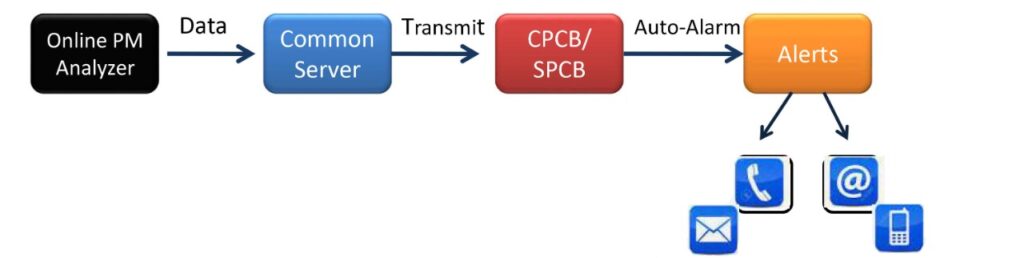
Online PM Monitoring Equipments are connected to Servers to transmit data through LAN / SIM Card based Cloud Gateway.
Cloud Server collect the analyzed data on every 1 minute frequency and generating files.
Average Frequency of transmitting data to CPCB/SPCB server through Cloud gateway is interval of 15 min.
Auto SMS Alerts have been generated to the dedicated e-mail address & registered mobile numbers .
INDUSTRIES WE SERVE
Govt. STPs
Textiles Industries
Dairy & food industries
Pharmaceutical Industries
Automobile Industries
Sugar Mills